
Captains of Industry?
Teams of students run twelve real companies in four linked industries, 1870–1910. While workers are plentiful, the owner who pays less can charge less: a race to the bottom driven by incentives. Halfway through, workers grow scarce and the incentives flip; unions and reforms follow.

Who sees what
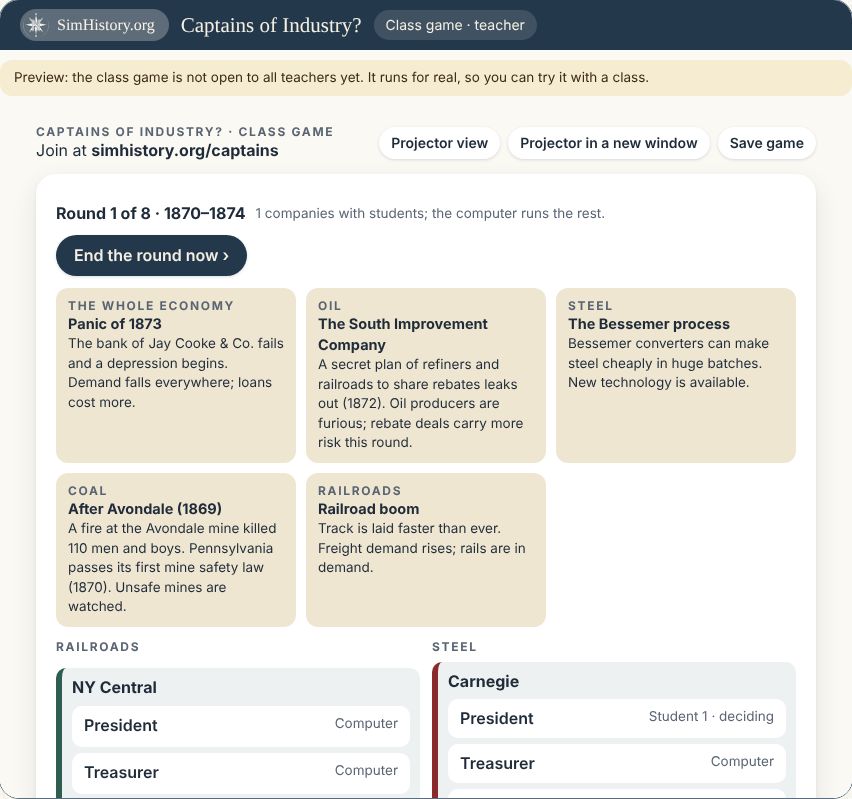
Your screen
- The codes (one per company, or one class code) and the seat board: click two seats to swap students.
- Each round's events, and who has locked in.
- End the round, Next round, Save game, and the projector.
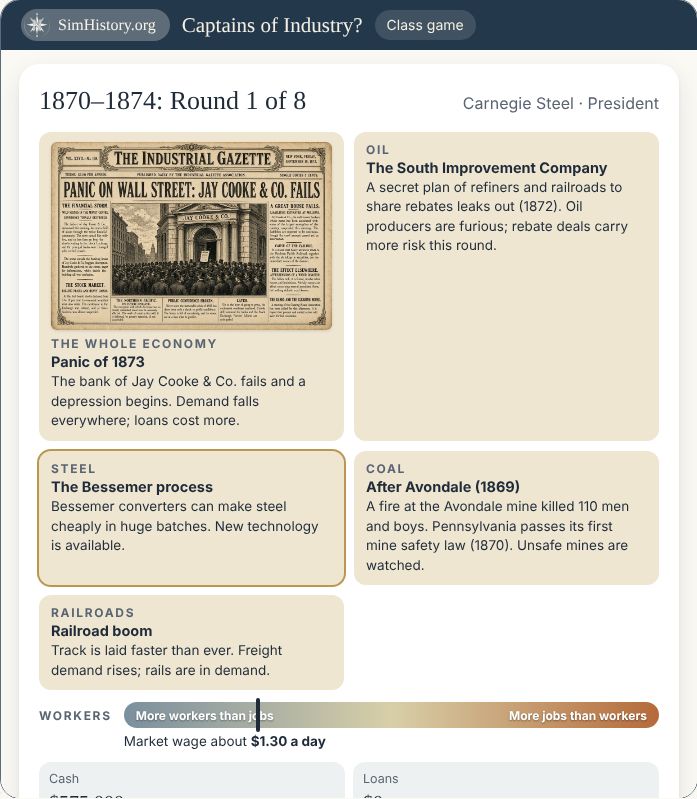
A student's device
- Their job only: the President sets price and makes deals; the Treasurer invests and borrows; the Superintendent sets pay, hours and safety.
- Teammates' choices appear live, with hints ("Workers are scarce: low pay means quitting").
- Lock in; trade jobs with a teammate.
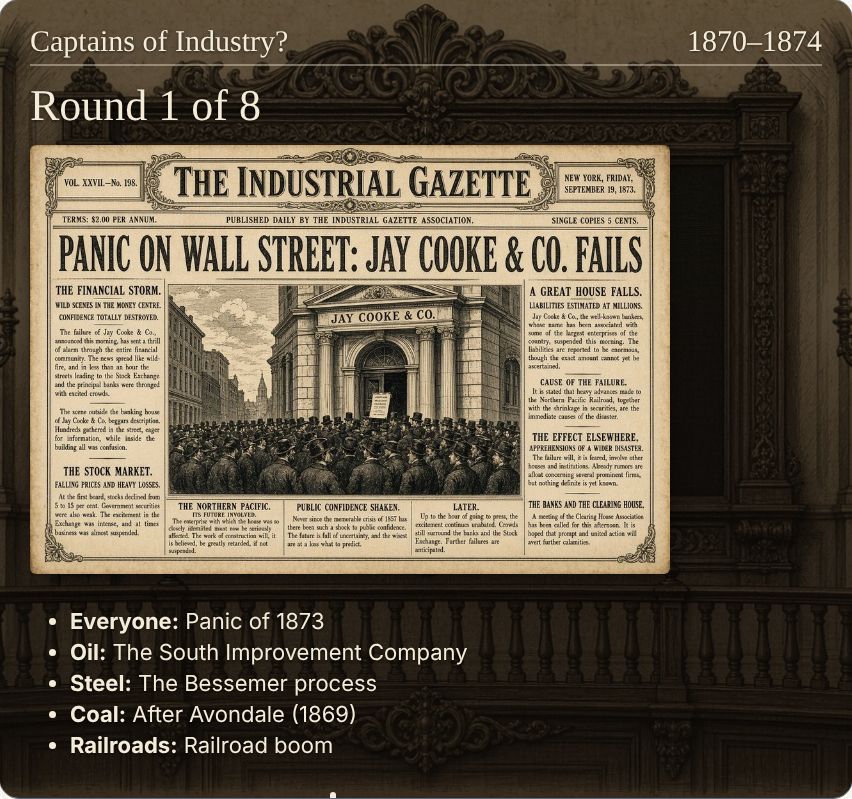
The projector
- The round's real front pages and the workers gauge.
- Who has locked in (never names or codes).
- After each round: the Industrial Gazette, share prices and standings.
Running the class
- Set upbefore class
- Open the class game. Choose industries (each has three companies), 2 or 3 students per company, and how students get seats: a code for each company (post them to groups), or one class code with random, chosen or teacher-placed seats. Jobs can be first come or assigned.
- Leave "the computer plays empty seats" on, so every company runs even when someone is absent. You can move anyone at any time.
- Seats10 minutes
- Students go to simhistory.org/captains and enter their code. Each reads their real person's card. Then click Start 1870.
- Each round8–10 minutes
- Read the front pages on the projector together.
- Teams decide; Presidents negotiate with other companies: coal sells to steel and railroads, steel sells rails, railroads carry everyone. Encourage face-to-face deals, then send the offer on screen.
- When the projector shows everyone locked in, click End the round. Read the Gazette headline aloud and ask one "why?" question.
- A company fails? Its students go up for hire. While the results are up, Presidents with a computer-played seat bid a signing bonus; the highest bid wins when you click Next round. With no bids, the computer places them (same industry first).
- 1890the turning point
- Point to the workers gauge: now there are more jobs than workers. Ask: "What will happen to companies that keep paying below market?"
- 1900sreform
- Unions ask for recognition; muckrakers raise the cost of a bad reputation; rebates, pools and child labor bring fines.
- 1910the end
- The winners (mogul names only), report cards, and "why it worked." Students write the annual report and letter to Congress and download one PDF. Grade the reflection, not the result.
- Not finished? Click Save game; next time, Open saved game and students rejoin with the same codes.
Content note. Accidents appear as headlines and numbers; child labor appears as a choice for coal companies and in Lewis Hine's photograph. Violence (Homestead, Pullman) appears only as news, never as a choice. Privacy. Students never sign in or type a name until their own PDF; your screen shows seats, never names.
First time? Try it side by side to play the teacher and two students at once. The lesson plan has objectives, standards, timing, model answers and a rubric.